Cathodic Protection Network
International

The procedure that is in use to examine the coating condition of the VRESAP pipeline is refered to as PCM which is the abreviation for Pipeline Current Mapping.
An alternating current is transmitted through a cable to the pipeline metal. The return path is connected to a grounding facility and the signal is detected by a receiver held by an operator walking over the pipeline.
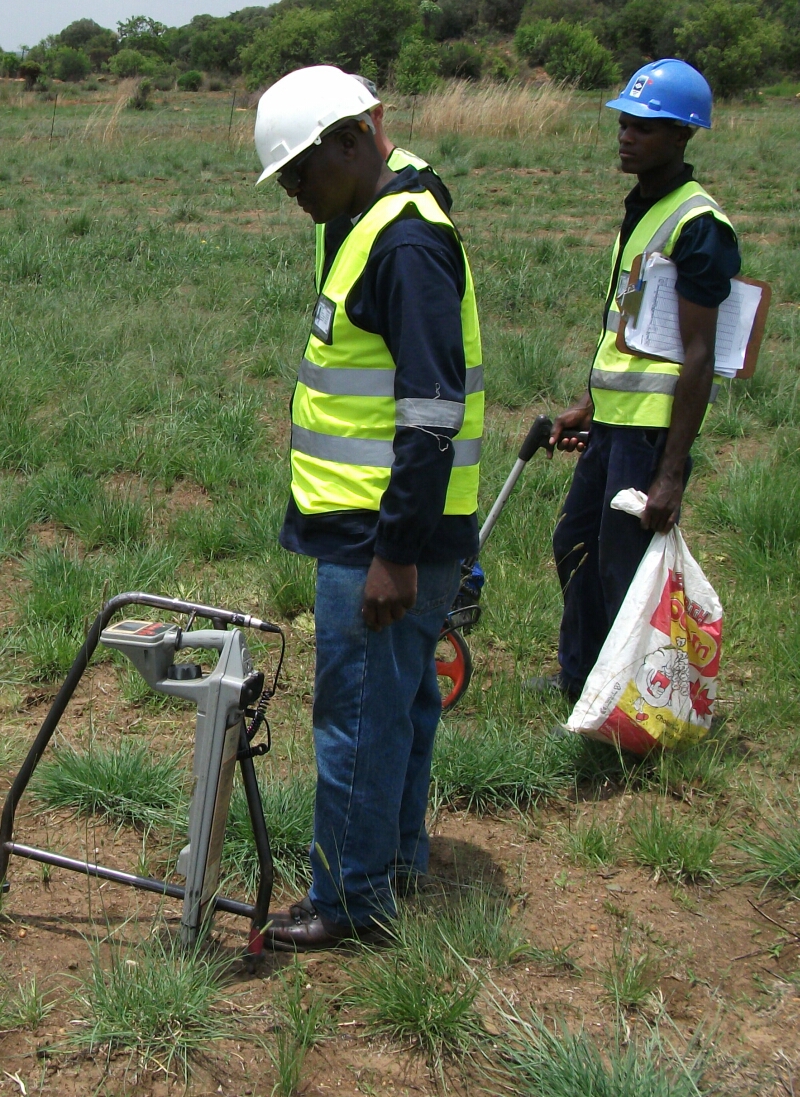
This is a development on the pipeline detection system that was known as a Pearson Survey and the handheld unit is identical one of the later models.
This is a link to a report of this technique.
It does not mention that AC induces current into any metal running parallel and that this causes confusion in areas where 'foreign pipelines' and metalic structures are present.
The main problem with instruments based on these principles is that it is not deterministic. In other words it cannot yield results on which calculations can be based.
The reason for this is that the energy radiates from source and is carried along metalic paths in which it is restricted by resistance. The escape of the energy at coating faults reduces the signal strength of the carrier and the escaping energy radiates through the media it encounters.
When using such devices to locate pipeline it is directional aerials that make it accurate and allow a reasonable procedure to determin the depth of cover.
Anyone who has used these devices in the field is aware of the many circumstances in which the fail to give the predicted results and the many where they prove to be very accurate.
During the development of Close Interval Potential Surveys, I strapped a tape recorder to such an instrument and recorded the audio signal resulting from the AC receiver unit. This produced a measurable trace from an analogue recording voltmeter which I was able to graduate to the signal strength in decibals. By causing 'events' to mark the locations of interest I was able to identify coating faults in a repeatable manner not possible when dependant on operator skills.
This was reported by British Gas in one of it's publications and the coming of more capable electronic designers and computerised circuitry has now changed it's name from 'Recorded Pearson Survey' to Pipeline Current Mapping.
The only current it maps is that which is transmitted by the system itself but it is a valuable tool when used with other procedures.
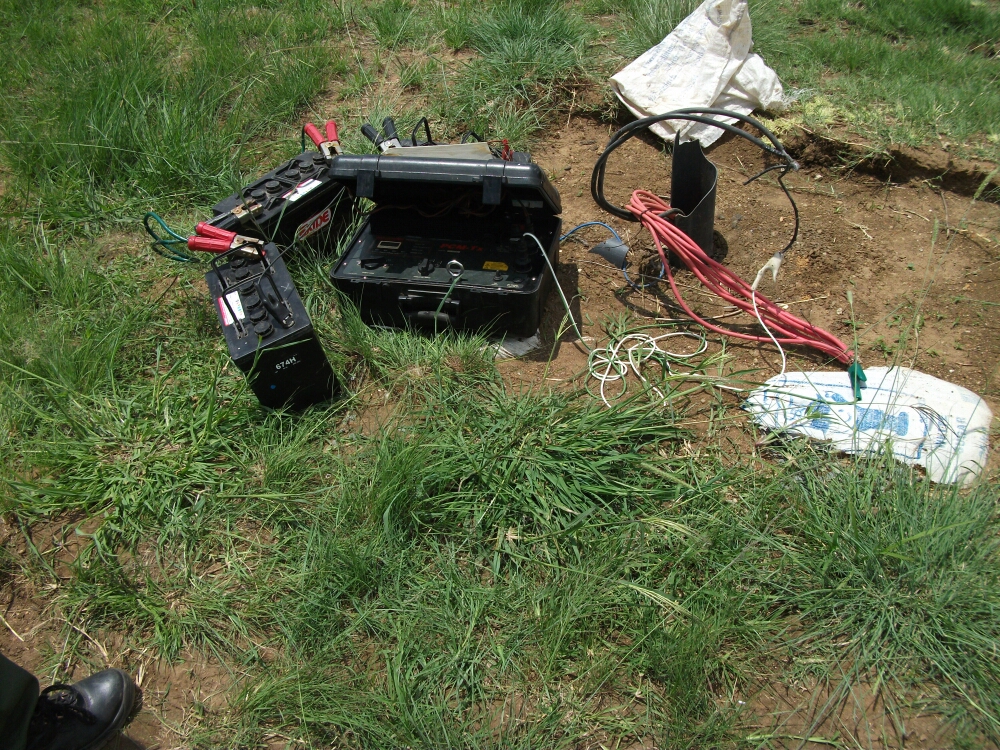
It can be seen from the photographs that this system is still very much operator dependant and it is therefore essential that the field technicians understand the principles on which the system depends.
This system compares very favourably with Dr Leeds DCVG but cannot have the accuracy of the CPN Two-half-cell Survey Procedure which can be refered to a single static potential and the corrosion reaction.
PCM does not reflect the corrosion status of the coating faults it identifies as the energy it transmits and measures is nothing to do with any electro-chemical reaction.
Link to front page