Current density
The term current density is used a lot in cathodic protection discussions but needs examining as the density of current cannot be measured in field work.
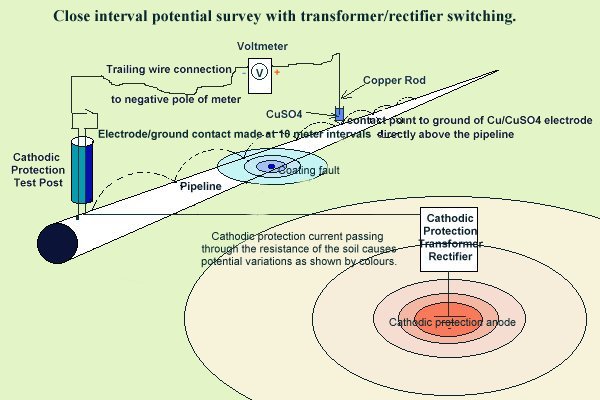
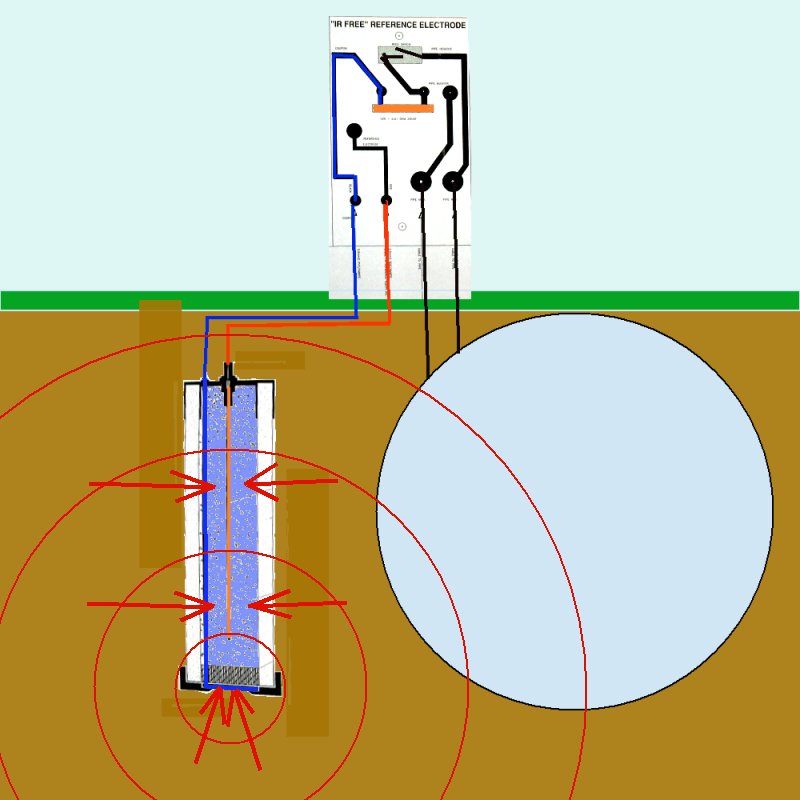
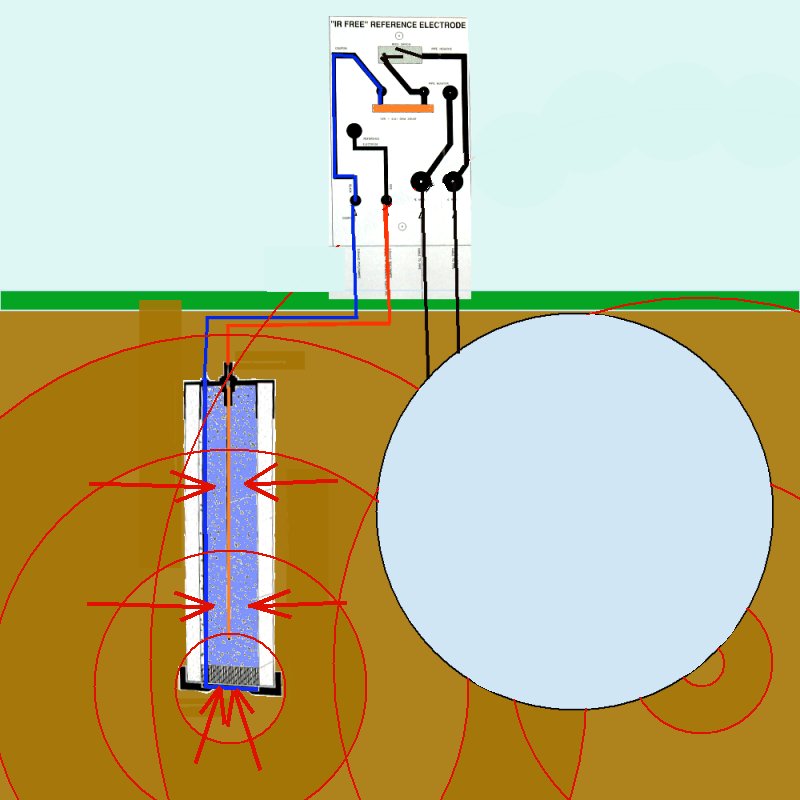
Current is the passage of charges through a medium and cathodic protection impresses current into the earth itself. Having passed from the anode of a cathodic protection system they will diffuse through the least line of resistance to earth with a lower potential according to Kirchoff's laws.
The measurement of current requires two points of contact in a confined path between two potentials. This is easily achieved in an electrical circuit made of conductive metal that is insulated from the rest of the circuit but is not possible where the charges are randomly dispersed in 'mass earth'.
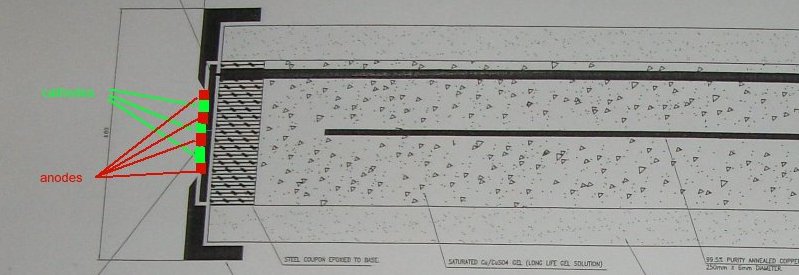
The coupon system suggested in these specifications measures the current passing through a shunt between the surface of the steel plate and the pipeline metal. This current is subject to the resistance of the earth (electrolyte) at both the anodic and cathodic interfaces.
The amount of current depends on the potential of the earth, the EMF at the anodic interface and the resistances of the earth path and any polarisation film that builds up at the cathodic interface.
The resistances in the earth path depend on the size of the coating fault and the conductivity of any disolved salts. This conductivity is a function of the forming of detectable 'potential zones' or 'shells of resistance' that have been misnamed as 'the IR drop in the soil'.
It is in fact the potential of each of these 'shells' that defines the number of charges available and this could resonably called 'current density', since this is controlled by many variables it is not possible to calculate the amount of current required to stop corrosion on any pipeline.
Attempts have been made to calculate current flow through sections of soil and water but they have never been successful. The present attempt to calculate the current flowing onto a given area of steel is successful but meaningless.
The report describes micro-amps and current densities using graphs based on 24 hour current logs. These are related to the coupon surface area and attempt to relate this to an estimated area of bare metal at coating faults on the pipeline. The number and size of coating faults can never be made with any degree of accuracy on any pipeline.
The specification of the experience in manufacture of the reference electrode and coupon system is entirely unnecessary as the product itself can be examined in detail for compliance. It is technically irrelevant how it was made and by whom.
The content of the Cathodic Protection Network on-line course explains all of the above with repeatable experiments so that theory is supported bt repeated observation as required by any serious scientist or engineer.