

|
|
|
Letter to MP
I attended this meeting as a result of the above letter, that was addressed to me by name, to have a chat about any important issues I might want to raise with Peter Swallow. 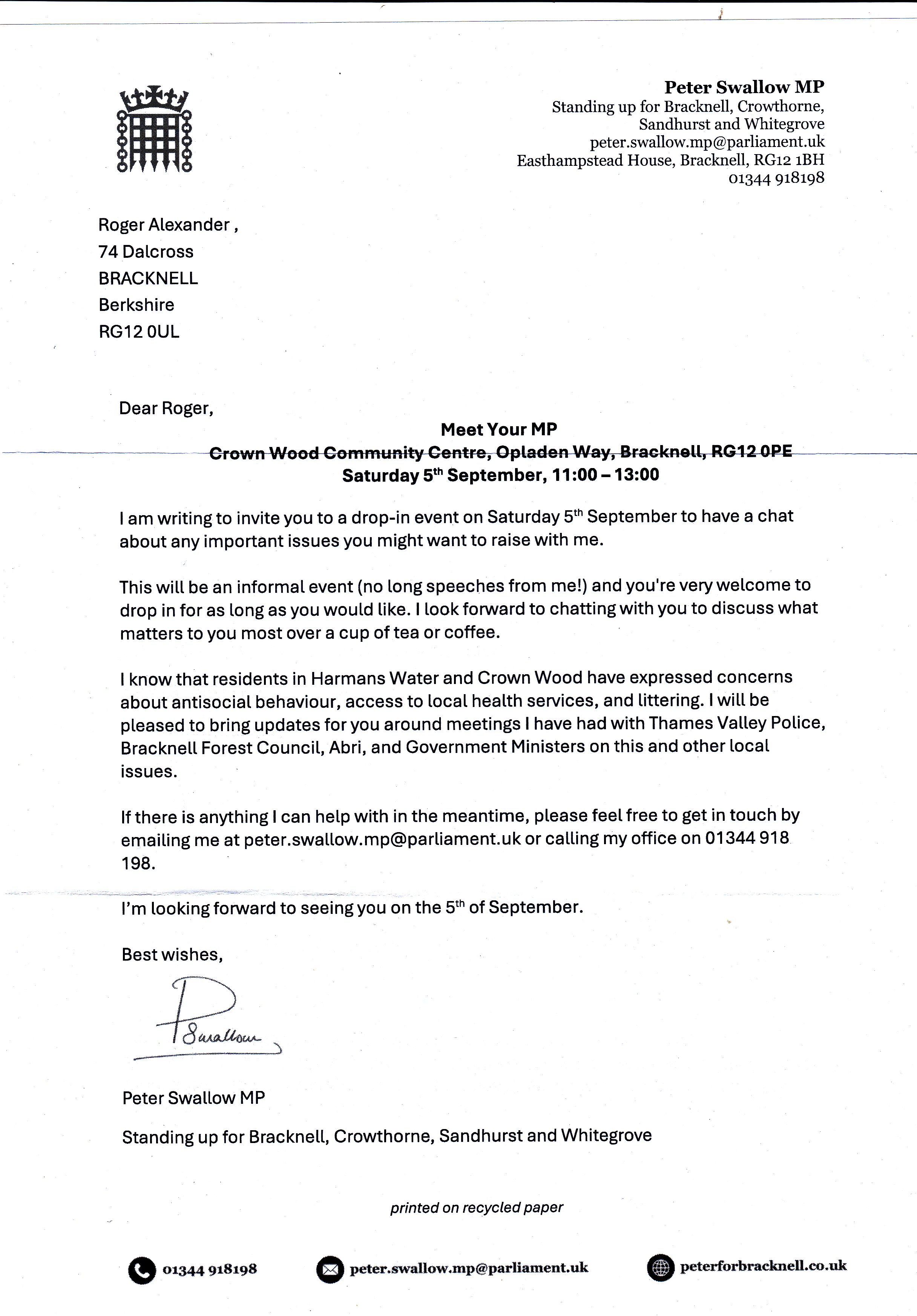
There was a table and several people at the entrance, checking our identities before we were allowed into the main hall that had been filled with a number of tables with a chairs around them. The cafe was open giving biscuits and tea. This was not a public meeting at which politics could be debated.
I sat at one end of a table of six and the hall filled with more people than there were tables and chairs, the excess being seated along the walls. I had a printed copy of this docment that I showed and discussed with the people at my table. I also had a tablet linked to this document that interested people could read on their mobile phones.
Peter Swallow came to our table and talked to each person about their issues answering loud enough for us all to hear. When he came to me he just said "I know about your issues Roger". I pushed this printed HTML doc into his hands but he put it down on the table. He stood up and left for another table.
Shortly afterwards a young man with an ID and a load of forms sat at our table and made notes of each persons issues. I told him my issues would not fit on his form and insisted that he took the printed document and noted the links to my correspondence with the government on his mobile phone in front of the witnesses at our table.
Peter Swallow returned briefly to our table, before he departed, to say good bye and I stood up and shook his hand and said "You are doing good Peter"
This whole meeting was frightening for me as I notice two police officers armed with tazers and handcuffs as well as other 'security' personel.
# A Centre of Scientific Excellence
Everybody is concerned about energy and the cost of keeping homes and businesses running.
But energy has to be transported, and much of it travels through pipelines. One of the greatest long-term threats to that infrastructure is corrosion.
Corrosion is a natural process governed by the laws of physics and chemistry. You cannot pass a law telling steel to stop corroding. It has to be controlled through engineering based on real, measurable science.
That is what I have spent my life working on.
We developed the Alexander Cell, and we have accumulated approximately 36,000 copyrighted scientific files covering our research and development.
But there is a problem.
What happens to this knowledge when I am no longer here to teach it?
That is why I am asking for your help.
I want to identify a suitable existing building and establish a permanent Centre of Scientific Excellence in Corrosion Science, Electrochemistry and Cathodic Protection.
It would be a place where scientists and young innovators could learn, carry out research, develop the Alexander Cell and its associated software, and build upon the knowledge we have already created.
It could also become an international centre where scientists and engineers can collaborate, hold masterclasses and share knowledge.
I am not asking for personal support.
I am asking for help creating an institution that can outlive me.
We have the science, the intellectual property, the international network and the continuing work.
Now we need a permanent home for it.
Preserve the knowledge. Transfer the knowledge. Develop the science. Train the next generation.
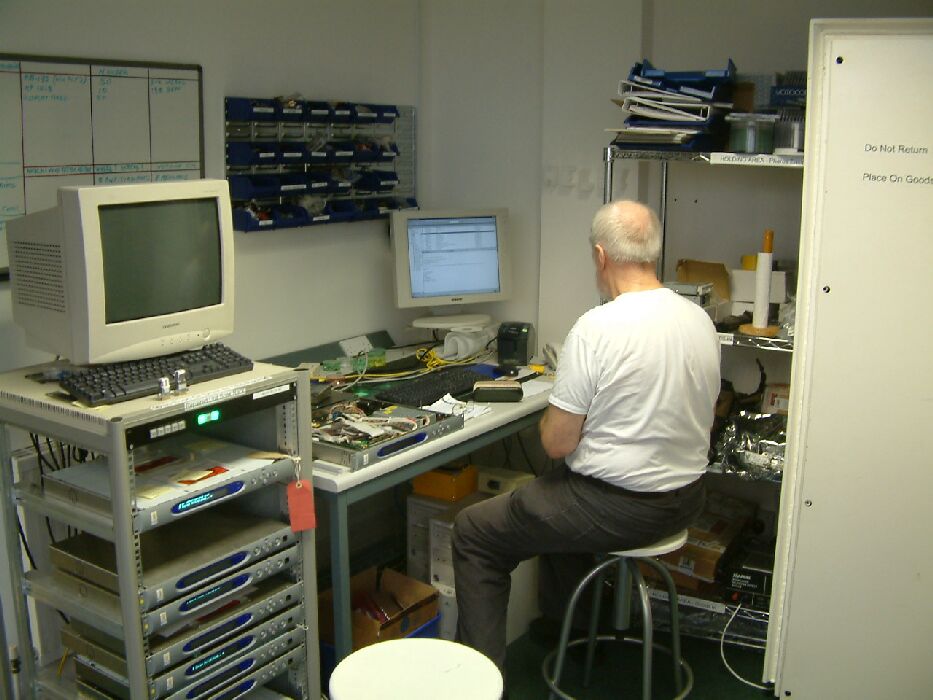
I am not asking for personal support. I am asking for recognition of a body of scientific knowledge that needs to be transferred to the next generation.
For many years I have worked in corrosion science, cathodic protection and the measurement of corrosion processes. From that work we have developed the Alexander Cell, together with computer-based methods for studying corrosion at the level of the corrosion cell itself.
We have also built a substantial body of intellectual property and scientific material, including approximately 36,000 copyrighted files, covering decades of research, development, experiments, technical papers and scientific studies.
The important question now is:
What happens to this knowledge when I am no longer here to teach it?
That is why I believe we need to establish a permanent scientific base - a head office and laboratory where this knowledge can be transferred to scientists, engineers, innovators and young people.
There are suitable buildings and facilities in Bracknell that could potentially be brought back into productive use. The objective would be to create a working centre where scientists and young innovators can study corrosion, cathodic protection, electrochemistry, measurement systems, software and related areas of materials science.
The Alexander Cell would form one of the foundations of this work because it provides a practical way of investigating corrosion through direct measurement of the electrical processes involved.
This is not simply about preserving old research.
The work is continuing.
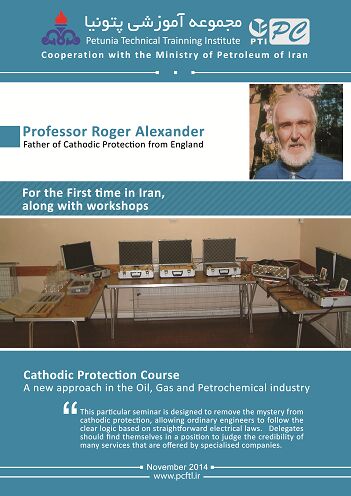
We are developing software. We are publishing material through the internet. We are building an international community. We are producing educational material, masterclasses and technical information, and we already have followers and contacts in many countries.
The internet now gives us the ability to connect this scientific centre with people around the world.
The centre could therefore become a place for:
scientific training; practical laboratory work; development of new corrosion-control technology; software development based on experimental measurements; training young scientists and engineers; preservation of scientific intellectual property; international masterclasses and conferences; collaboration between industry, scientists and innovators.
There is also a much bigger scientific opportunity here.
Modern technology increasingly depends upon enormous quantities of information, computing power, electrical energy and highly engineered infrastructure. Data centres, communications systems, satellites, mobile technology and industrial networks all depend upon physical infrastructure.
And that infrastructure ultimately depends upon materials.
Materials corrode.
Therefore, corrosion is not an isolated engineering problem. It is fundamental to the reliability and sustainability of the technological infrastructure on which modern society depends.
Our work connects the physical world - metals, electricity, electrochemistry and corrosion - with measurement, computation and scientific analysis.
That is why I believe this knowledge deserves to be transferred into a permanent centre rather than remaining dependent upon one individual.
I have spent decades developing this work. I want the knowledge to continue after me.
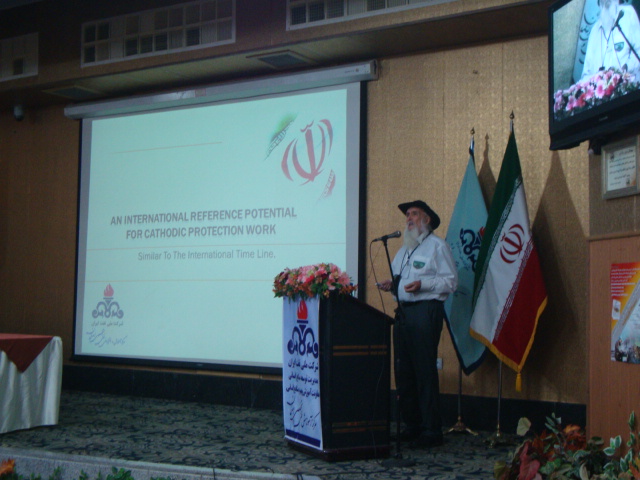
I would therefore like the MP to help us establish a pathway for a National Centre for Corrosion Science and Innovation, using an existing suitable facility, bringing together scientists, engineers, young innovators and international collaborators.
The objective is simple:
Preserve the knowledge. Transfer the knowledge. Develop the science. Train the next generation.
We have already done much of the groundwork.
Now we need an institution capable of carrying it forward.